
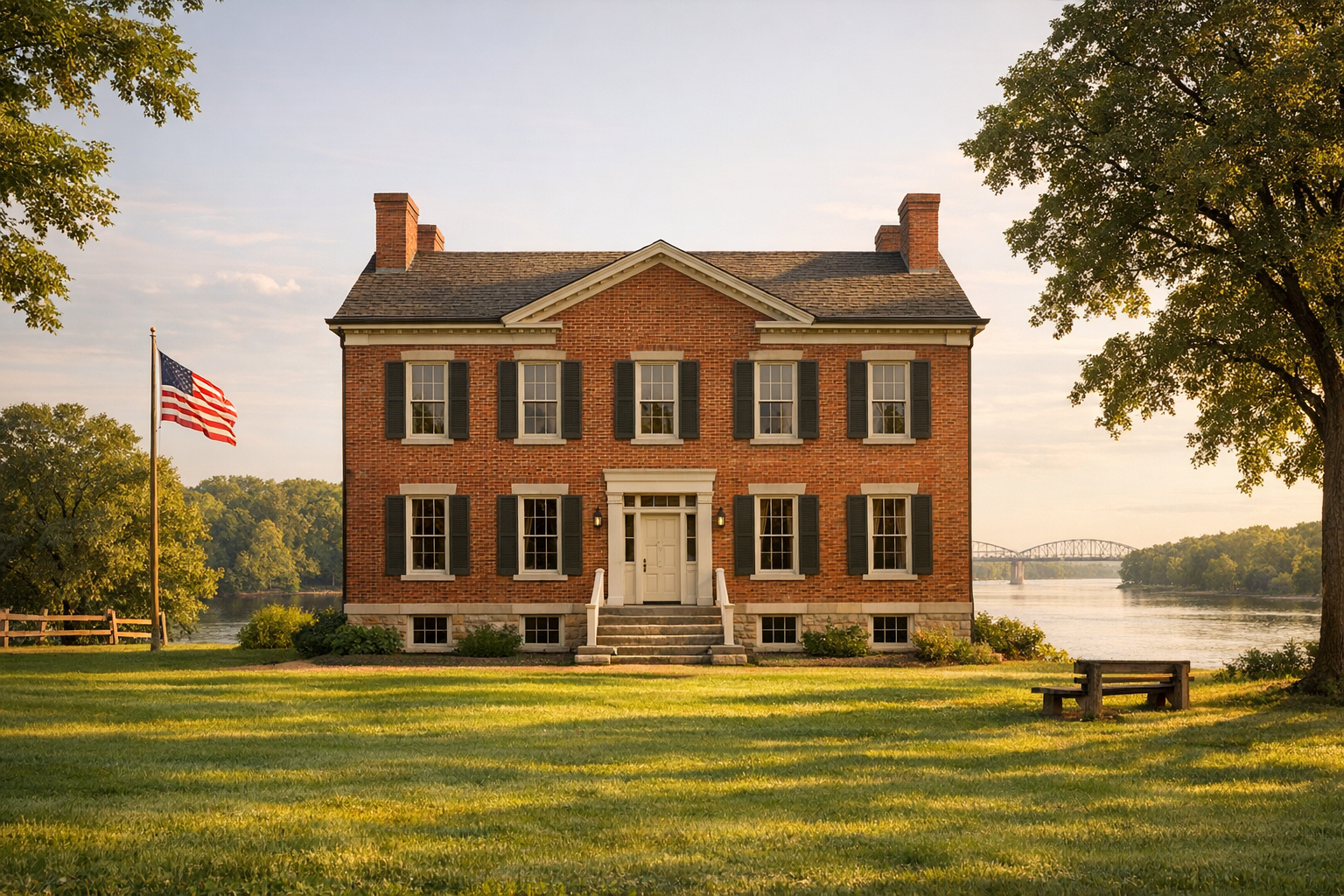
The Colonel Davenport House, located on Arsenal Island in Rock Island, Illinois, is a historic site offering insights into early Mississippi pioneer life. Built between 1833 and 1834, this Federal-style mansion was once a hub of trade and commerce tied to Colonel George Davenport, a fur trader and key figure in the region's development. The house is notable for its architecture and its tragic history, as Davenport was murdered there in 1845.
Visitors can explore guided tours featuring period furnishings, fur trade exhibits, and restored architectural details. Open from May to October, the site requires security clearance to enter Arsenal Island. Admission is $6 for adults, $4 for seniors, and free for children under 12. Other attractions nearby include the Rock Island Arsenal Museum and the Mississippi River Visitors Center.
Key Highlights:
- Built in the 1830s, the house is one of the westernmost examples of Federal-style architecture in the U.S.
- Features exhibits on pioneer life, the fur trade, and Davenport’s legacy.
- Located on a functioning military base, requiring ID and a background check for access.
- Nearby attractions include riverfront views, historic sites, and museums in the Quad Cities area.
Plan your visit to experience a piece of mid-19th-century history while enjoying the scenic Mississippi River backdrop.
Illinois Adventure #1501 "Colonel Davenport House"
History of the Colonel Davenport House
@figure 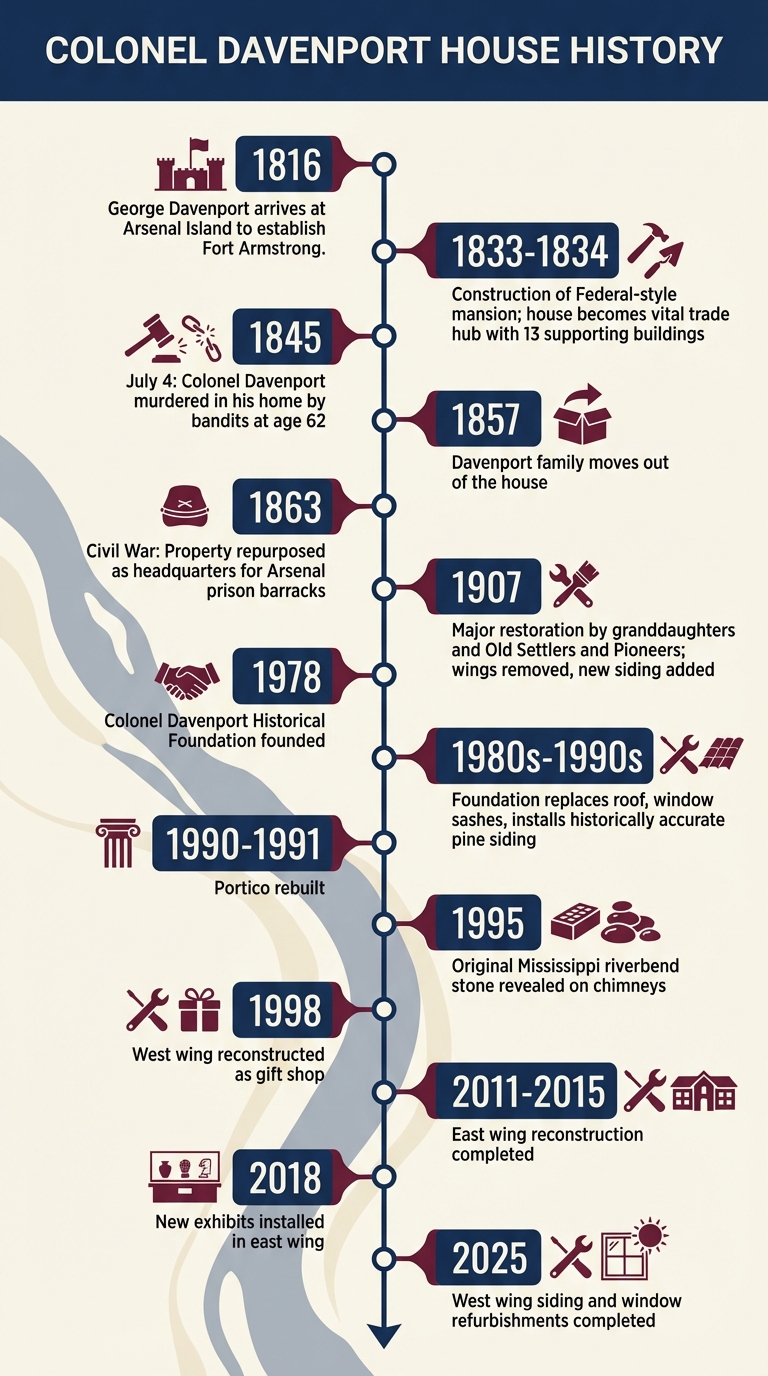 {Colonel Davenport House Timeline: From Construction to Modern Restoration}
Colonel George Davenport's Life and Work
George Davenport first arrived at Arsenal Island in 1816 as part of the U.S. Army, tasked with helping establish Fort Armstrong. After his military service, he shifted his focus to trade, becoming a prominent figure in the region. As an agent for the American Fur Company, Davenport traded with local Native American tribes and even made history by sending the first keelboat-load of lead down the Mississippi River to St. Louis.
Davenport’s impact wasn’t limited to commerce. During the Black Hawk Wars, he played a key role as a mediator between Native American tribes and the U.S. Government. By the early 1830s, his property had grown into a vital trade hub, complete with 13 supporting buildings.
How the House Was Built
Between 1833 and 1834, Davenport constructed his mansion, which stood out for its advanced design at the time. A local carpenter meticulously squared and notched the logs, later covering them with furring strips and pine clapboards to create the house’s distinctive Federal Style.
The original layout included a central structure flanked by east and west wings, with an additional kitchen wing to the south. Notably, the west wing doubled as Davenport's office. This design not only reflected the resourcefulness of the era but also showcased a regional adaptation of Federal-style architecture. Remarkably, the house is one of the westernmost examples of this architectural style in the United States.
The 1845 Murder
On July 4, 1845, tragedy struck when Colonel Davenport, then 62 years old, was murdered in his own home by bandits. Despite this grim event, the Davenport family continued to live in the house until 1857. During the Civil War, in 1863, the property was repurposed as the headquarters for the Arsenal prison barracks and housed the prison commandant.
What to See on the Guided Tour
Period Furnishings and Artifacts
Step inside and be transported back to the 1830s and 1840s. The guided tour offers a glimpse into life during this era, with historically furnished interiors and authentic artifacts that showcase how the Davenport family lived. Every detail, down to the wood trim, has been restored with period-accurate wood graining to maintain historical integrity.
Upstairs, you'll find a fascinating fur trade exhibit that dives into the history of this crucial industry. In the east wing - completed in 2015 and fully outfitted with exhibits by 2018 - modern displays provide deeper insights into 19th-century life. One standout feature is the "Steering the Rapids" board game, which demonstrates the challenges river navigators faced on the Mississippi during Davenport's time. All of this is beautifully complemented by the mansion’s striking architectural details.
Architecture and River Views
The house itself is a masterpiece of Federal-style architecture, featuring a log-structure skeleton covered in pine clapboards. Its distinctive look is further enhanced by stone chimneys along the Mississippi riverbend and a reconstructed Federal-style portico that adds to its charm. The mansion’s location, facing the Mississippi River’s main channel, offers breathtaking views and serves as a reminder of its historical role in regional trade.
Standing here, it’s easy to see why Davenport chose this spot for his fur trading operations and keelboat shipments. The river was more than a scenic backdrop - it was the lifeblood of commerce and connection in the early 1800s. Behind the house, a garden maintained by the Tri-City Garden Club adds another layer of historical authenticity.
National Register of Historic Places Listing
The house's significance extends beyond its walls. Recognized on the National Register of Historic Places, it stands as one of the westernmost examples of Federal-style architecture in the United States. This prestigious designation not only highlights its architectural importance but also underscores its place in Quad Cities history as the region’s oldest permanent residence.
Thanks to the efforts of the Colonel Davenport Historical Foundation, preservation work continues to honor the home’s legacy and ensure future generations can appreciate its rich history. This recognition cements its role as a vital piece of both local and national heritage.
Restoration and Preservation Work
Efforts to preserve the Colonel Davenport House have ensured its historical significance remains intact for future generations.
1907 Restoration by Family Members
By 1907, the Colonel Davenport House had fallen into severe disrepair. Years of neglect, coupled with damage from souvenir hunters, vandals, and weather, had left the structure on the brink of collapse. Recognizing the urgency, Colonel Davenport's granddaughters teamed up with the Old Settlers and Pioneers, a local group, to save the main Federal-style section of the house as part of their day trips around the Quad Cities. While the deteriorated wings were removed, new siding was added to the main structure. This siding remained for over 80 years until it was replaced with historically accurate pine wood in 1989. These early efforts laid the groundwork for the more extensive restorations that followed.
Modern Work by the Foundation
The Colonel Davenport Historical Foundation, founded in 1978, took on the mission of preserving the house and sharing its history. Throughout the 1980s and 1990s, the Foundation spearheaded several key restoration projects. They replaced the roof and window sashes, installed pine wood siding to match the house's original 1830s design, and rebuilt the portico between 1990 and 1991. In 1995, the stucco was stripped from the chimneys to reveal the original Mississippi riverbend stone. By 1998, the west wing was reconstructed and repurposed as a gift shop.
Recent Updates
Building on decades of work, the Foundation began reconstructing the east wing in 2011, completing it in 2015 with support from local organizations like the Community Foundation of the Great River Bend, Doris & Victor Day Foundation, RIA Development Group, and the Scott County Regional Authority. By 2018, new exhibits were installed, though some maintenance challenges emerged. Most recently, in 2025, the Foundation completed siding and window refurbishments for the west wing, backed by the Regional Development Authority and the Rock Island Arsenal Spouse and Community Club. Additional updates, such as replacing a ramp and installing a new flagpole, have further enhanced the west wing.
sbb-itb-396215c
Planning Your Visit
The Colonel Davenport House welcomes visitors from May through October, offering guided tours on Fridays and Saturdays between 12:00 p.m. and 4:00 p.m.. Admission includes a tour of the historically furnished house and its grounds, and it’s recommended to set aside 1–2 hours for the experience. Ticket prices are $6 for adults, $4 for seniors aged 65 and older, and free for children 12 and under. Active-duty military members and their families can enjoy free admission from Armed Forces Day through Labor Day under the Blue Star Museums program.
Hours and Tour Schedule
Since the house is located on Arsenal Island within the Rock Island Arsenal - a functioning military base - security clearance is required to enter. Visitors 18 and older must stop at the Visitor Control Center at 23 Prospect Drive, Moline, IL 61265, before heading to the site. You’ll need to present a valid state REAL ID or U.S. Passport. If you don’t have a REAL ID, bring an additional form of identification, such as a birth certificate. All adults must pass a criminal background check to gain entry, while children under 16 are exempt but must be accompanied by an adult who has completed the necessary checks.
Getting Through Rock Island Arsenal Security
Access the installation through the downtown Moline gate. The Colonel Davenport Historical Foundation notes:
The process is quick.
To save time, you can download and fill out the required background check form from the website before heading to the Visitor Control Center. There’s no need to pre-register vehicles like cars, vans, campers, motorcycles, or bicycles, but bus groups must register in advance. Keep in mind that foreign nationals are typically not permitted to enter the island unless they are there for official business.
Tips for Your Visit
The first floor of the house is wheelchair accessible, but access to the second floor is limited to stairs. While visiting Arsenal Island, you might also want to check out the Rock Island Arsenal Museum or the Mississippi River Visitors Center. It’s always a good idea to confirm that the house is open before making the trip, as hours may vary due to seasonal weather or other factors. After your tour, take some time to explore other historic attractions in the Quad Cities area.
Other Attractions in the Quad Cities
The Quad Cities region is brimming with historic landmarks and picturesque spots that go far beyond the Davenport House. Whether you're a history buff or a nature lover, there's something for everyone.
Historic Sites and Museums
Dive into the rich history of the area with a visit to some fascinating sites. The Rock Island Arsenal Museum is packed with detailed exhibits on military manufacturing and the Arsenal's storied past. You can also learn about Fort Armstrong and the legacy of Black Hawk through its displays. For a reflective experience, the National and Confederate Cemeteries on Rock Island offer a poignant look at military history. If you’re in the mood for something more serene, the Quad City Botanical Center in Rock Island is a must-see. Its indoor tropical gardens and outdoor displays provide a peaceful escape.
Mississippi River Spots
The Mississippi River is a showstopper in the Quad Cities, and the Colonel Davenport House takes full advantage of its stunning views. For a relaxing outing, head to Schwiebert Park for scenic walks and great photo opportunities. At the Mississippi River Visitors Center at Lock and Dam #15, you can watch barges navigate the locks while learning about the ins and outs of river transportation. These riverfront destinations offer a perfect mix of education and natural beauty.
More Day Trips on QC.LocalDayTrips.com
If you're looking to expand your adventures, QC.LocalDayTrips.com is an excellent resource. The site helps you discover nearby attractions, from historic landmarks to nature preserves, with filters like "Less Than 1 Hour Away" or "1–2 Hours Away" to tailor your plans. For instance, you can explore the trails through sandstone canyons at Starved Rock State Park or walk across a 375-million-year-old ocean floor at the Devonian Fossil Gorge. The site even offers handy articles, like "Hiking vs Museums: Best Quad Cities Weekend Plans", to help you strike the perfect balance between outdoor fun and cultural exploration.
Conclusion
The Colonel Davenport House stands as a testament to the rich history of the Quad Cities, preserving the legacy of Colonel Davenport and his role in transforming the area from a military outpost into a bustling community. As the region's oldest permanent residence, this Federal-style mansion offers a glimpse into the past and the pivotal moments that shaped the local heritage.
Visitors can step back in time with guided tours that showcase period furnishings, the fur trade era, pioneer life, and the tragic events of 1845. The house itself, with its distinctive log frame covered in pine clapboards, and its strategic location on Arsenal Island, highlights its importance in the region's history.
While you're there, consider exploring other attractions on Arsenal Island, such as museums and scenic river overlooks, to enrich your experience. For more inspiration and ideas for day trips in the Quad Cities area, check out QC.LocalDayTrips.com and start planning your next adventure.
FAQs
The Colonel Davenport House, constructed between 1833 and 1834, stands as one of the Quad Cities' oldest surviving homes and offers a rare example of Federal-style architecture in the area. Once home to Colonel George Davenport - a fur trader, U.S. Army sutler, and the region’s first white settler - the house carries historical significance, as the city of Davenport, Iowa, was named in his honor.
This historic residence also played a part in military history, serving as a headquarters during the Civil War era. Today, visitors can explore the meticulously restored home to uncover stories of early pioneer life, the fur trade, and the transformative development of the Mississippi River frontier. It provides a unique window into the forces that shaped the American Midwest.
To visit the Colonel Davenport House, head to Arsenal Island through the downtown Moline gate. First, stop by the Visitor Control Center at 23 Prospect Drive, Moline, to get your visitor pass. Make sure to bring a valid state ID or passport, as a background check is required for access. If you have a federal ID, you can skip this step entirely. Once you’re cleared, you’re ready to dive into the history of this fascinating site!
Visiting the Colonel Davenport House is like stepping back into the early 19th century. This restored 1833 Federal-style mansion showcases original rooms filled with period furnishings and artifacts, giving you a window into pioneer life. It also highlights the legacy of Colonel George Davenport, whose work in fur trading and military service shaped the history of the Mississippi Valley.
The house offers a hands-on way to connect with the region's past, making it an engaging stop for history buffs and families looking to explore something memorable.